
Michigan Mugshot Access
No single Michigan rule puts every booking photo on the web. Michigan has no broad law barring publication of booking photographs. No general statute makes paid removal a crime. And no official portal wipes out every private copy. That is a narrow answer, since other laws, court orders, privacy rules, and the facts of a dispute can still matter. The real distinction is between two things. One is a record a public body holds. The other is a copy someone later publishes online. A public body is any state or local agency covered by FOIA. A sheriff may hold a booking image you can request under the act. A private publisher, though, runs on its own release and correction process. Public record never means automatic web posting.
| Question | Michigan rule in practice |
|---|---|
| Is a sheriff-held booking photo a public record? | It can be. The Court of Appeals addressed that question in a specific FOIA case. |
| Must each agency post every photo online? | No general online-posting duty was found. Agency release practice can vary. |
| Does an official correction erase copies? | No. Private pages, search results, and reposts may need separate requests. |
The Legislature’s MCL 15.231 sets the FOIA framework and defines the public-record route.
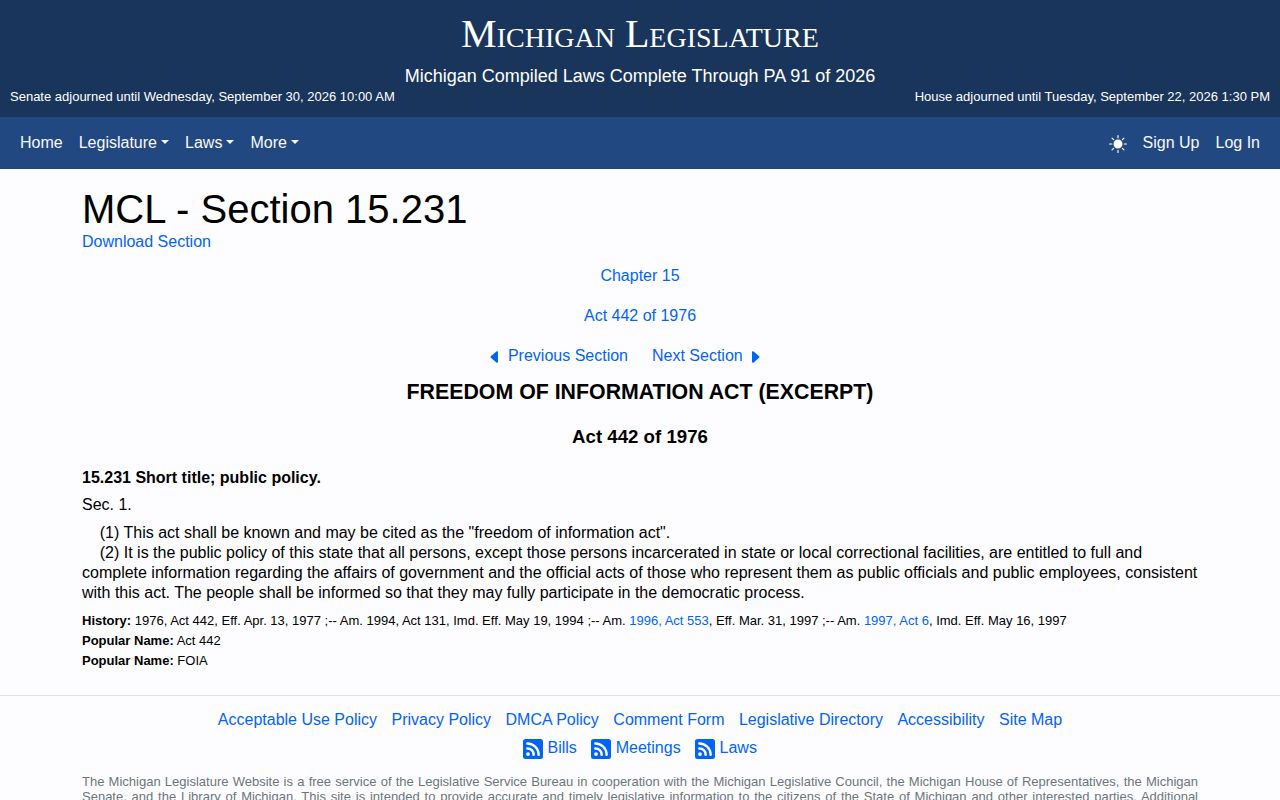
The statute lets you ask a public body for records in its files. It does not turn those records into a live online feed.
Michigan FOIA Mugshot Records
Michigan's main access statute is FOIA, MCL 15.231 and following. Put any request in writing. Describe the record clearly enough for the agency to locate it. For a booking image, give the person's full name, the arrest or booking date, and the agency. Add any jail or incident number you know. You do not have to show a special interest in the record. In Patterson v. Allegan County Sheriff, 199 Mich App 638; 502 NW2d 368 (1993), the Michigan Court of Appeals addressed a sheriff's booking photo. That photo counted as a public record. It rejected withholding based only on the privacy argument raised there. The holding matters, but it is limited. It does not require online publication. It also fails to settle every exemption or override a law that makes a record confidential. The Michigan Attorney General's FOIA information covers response times. An agency generally must respond within five business days. A ten-business-day extension is allowed. The response may grant the request, deny it, or split it. Fees can cover search, review, copying, separation, and mailing. Ask for a fee estimate, and narrow the request to the one record you need. A FOIA request only reaches records that already exist. It will not create a new photo. It cannot force an outside publisher to update a page either.
Michigan Mugshots Aren’t Always Posted
FOIA access does not reach every page in a file. MCL 15.243 lists exemptions. Exemptions are legal grounds to withhold part or all of a record. An agency may have to weigh personal privacy. It may also weigh an active investigation, a confidential source, or another protected interest, depending on the facts. A denial should be explained through the FOIA process. Some material can come out once protected details are removed. The Legislature's exemption section shows why. A public-record label never settles whether a photo is actually available.
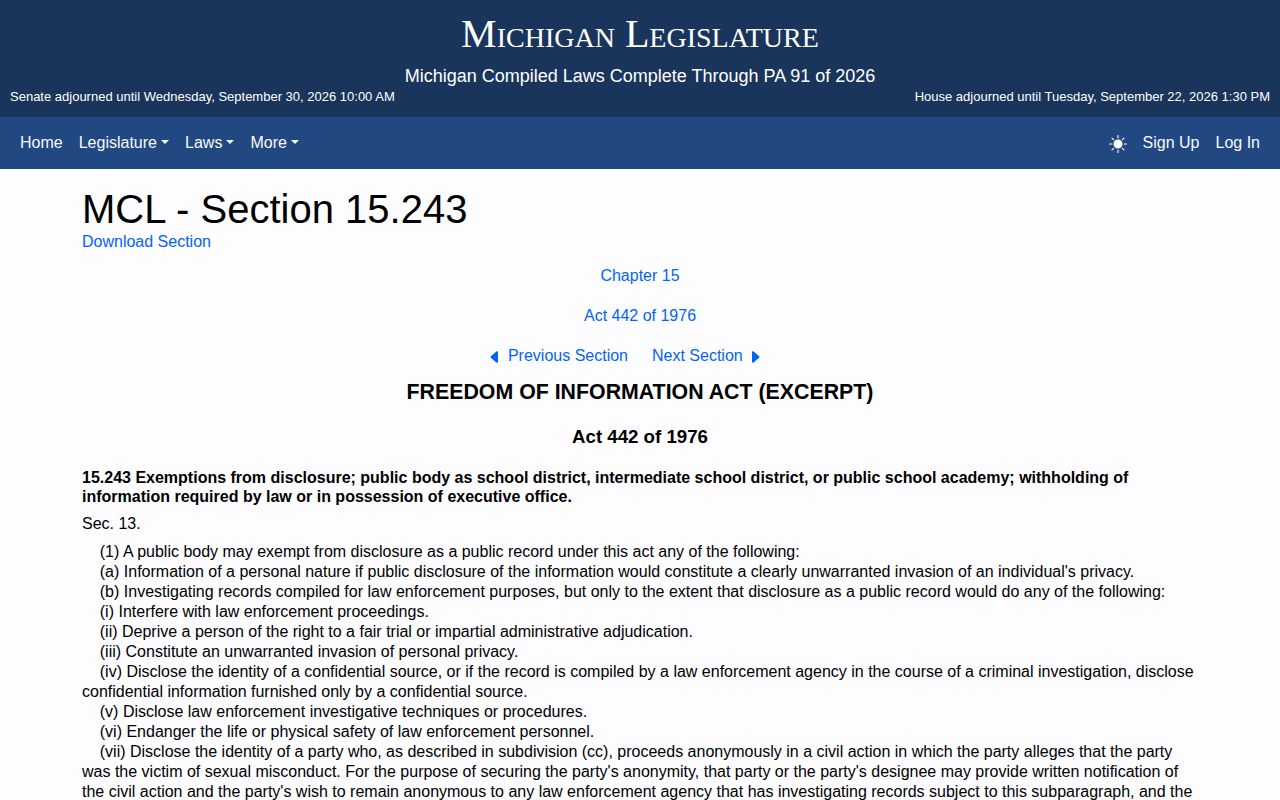
The statutory text is just text. A custodian still has to apply the law to the record and the circumstances. The Statewide Network of Agency Photos adds its own operational layer. Michigan State Police's SNAP acceptable-use policy says release rules depend on the agency that supplied a photo. Agency approval is generally expected unless FOIA compels disclosure. A photo there may travel a very different path. County rosters work differently. Federal records follow their own legal track. In Detroit Free Press v. Department of Justice, the Sixth Circuit held that federal FOIA privacy interests can justify withholding federal booking photos. That ruling does not disturb the Michigan Court of Appeals' narrower decision. That case concerned a sheriff-held state record.
Note: An exemption can cover only part of a record; ask whether non-exempt information can be released after protected details are separated.
Official Michigan Records to Check
A missing photo does not end the hunt for an official record. Start with the agency that made the arrest. If the source is unclear, the County Directory points to the right county site, and the statewide Michigan records overview explains how county feeds and records routes differ.
| Official route | What it can show | Key limit |
|---|---|---|
| County sheriff or local police | Roster entry, booking record, or a photo held by that agency | Posting and retention vary; ask the actual custodian. |
| FOIA request | A copy of an existing record held by a public body | Exemptions, cost rules, and response steps apply. |
| MiCOURT case search or clerk | Case events and a court disposition | Courts are not FOIA public bodies; court access rules apply. |
| Michigan corrections search | State-prison custody and offender profile information | It is not a county booking list. |
A disposition is how a court case ends. It may be a dismissal, an acquittal, or a conviction. That outcome lives in the court file. It is not the same thing as an arrest card or booking photo. Court rules govern what judicial records show online, and confidentiality limits apply. A case missing from a search may still exist. Ask the court that handled it. Keep record types separate, since a county jail roster, a court file, and a state corrections profile each answer a different question about custody, cases, and supervision.
Note: MiCOURT provides case-search information, not booking photos; contact the court if a case or older filing is missing.
Michigan Arrest-Card Corrections
Michigan law allows certain arrest cards to be fixed. The trigger is an outcome the statute names, such as a not-guilty verdict, a dismissal, or a nolle prosequi. A nolle prosequi formally ends a prosecution without a trial. MCL 28.243 sets the conditions and the procedure. The outcome can depend on agency or court action. It is not instant erasure of every record. The Legislature's Act 289 of 1925 contains the arrest-card and biometric framework behind these rules.
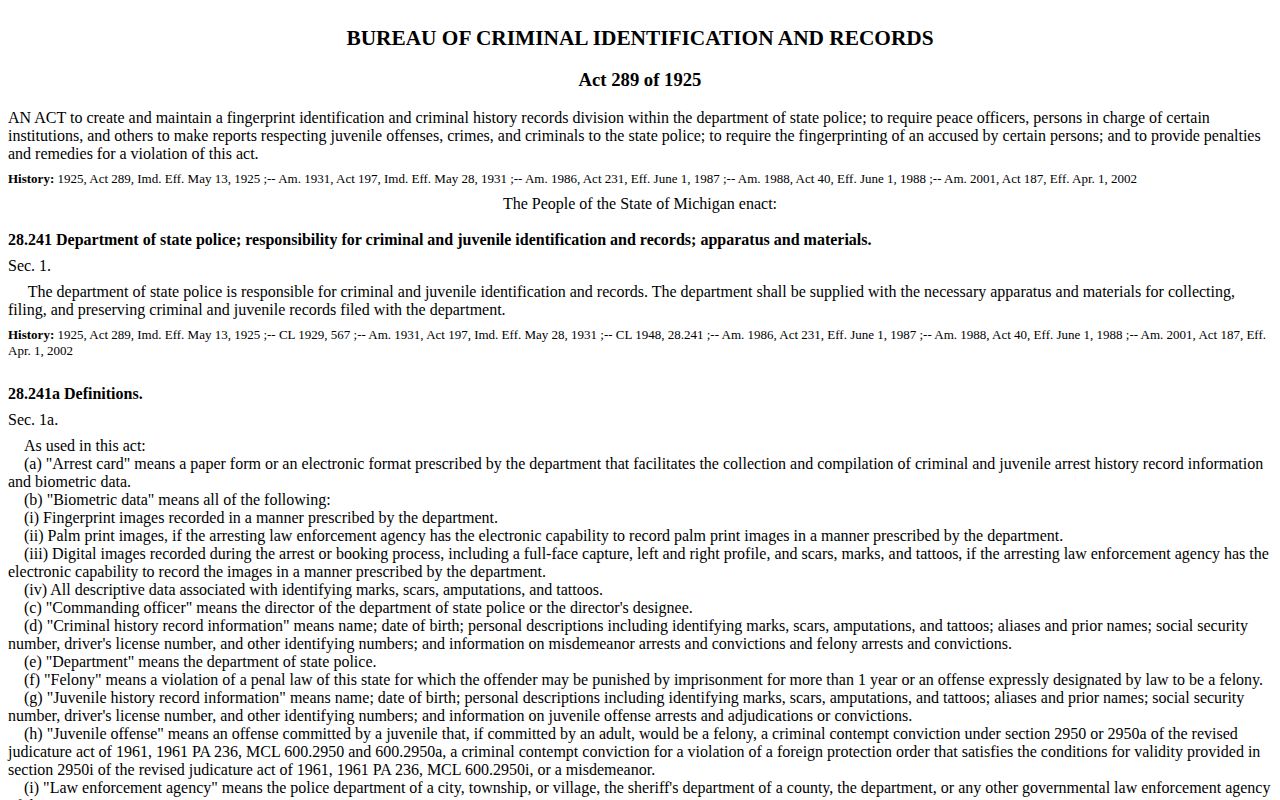
This record process stands apart from setting aside a conviction. Michigan's Clean Slate laws work differently. Some convictions are set aside automatically. Others require a petition. Eligibility turns on the offense, the record, the waiting period, and other limits. The Michigan State Police explains how to search, expunge, modify, or update criminal-history records. It also posts an official Michigan Clean Slate overview. People often quote seven years for qualifying misdemeanors and ten for felonies. Those waits are not a promise. The current MCL 780.621d sets the statutory terms, and a petition must follow the current court process, since offense exclusions, conviction-count limits, and automatic versus petition routes all matter.
| Record action | What it may change | What it does not guarantee |
|---|---|---|
| Arrest-card correction or destruction | Qualifying state arrest or biometric information | That every agency record or outside copy is gone |
| Conviction set-aside | Official access to a qualifying conviction under Michigan law | That every booking photo or news report disappears |
| Publisher correction request | A specific private page under that publisher’s policy | Removal from every site, search result, or repost |
Michigan Mugshot Correction Requests
A private page can be wrong, outdated, or tied to a changed court outcome. Fixing it means the publisher's own process. That path is separate from any government request. Recently Booked lists many correction categories. Dismissal, expungement, sealing, wrong person, incorrect details, juvenile material, and duplicate pages all qualify. Its policy wants the page URL, full name, and arrest date. Add the state, county, reason, and papers. An accurate listing stays up no matter who asks. The Recently Booked removal policy spells out the request path, though its terms bind neither another publisher nor the agency holding the source record.
Each policy covers one publisher only. Back any request with the record that explains the change, since a submission never guarantees removal of an accurate current listing.
Michigan Mugshots.com Corrections
Mugshots.com says its record-maintenance requests are free. Listed grounds include expungement, sealing, no information, restriction, identity theft, or death. A favorable result may mean an update, not removal. The publisher asks for signed court papers and the page's identifier. Its stated window is roughly ten business days. That target is not a promise, and the record-maintenance page itself is separate from any official Michigan record or court file.
Send the source document that supports the change. A publisher's stated review period binds no state agency or rival website.
Michigan Mugshots.zone Copies
Mugshots.zone describes itself as an aggregator. It says it will correct or remove sealed or expunged material when told. Its about page sets no uniform rule for every Michigan county page. Each request must name the exact page. Follow the publisher's current instructions. The site plays a secondary role, holding copies rather than official Michigan records or proof that a county sheriff runs any linked local page.
Private listings can be incomplete or stale. Treat each one as a copy needing separate verification, never as the official record or proof of current custody.
Michigan Juvenile Photo Privacy
Juvenile cases sit behind a different privacy wall. MCL 712A.28 governs confidentiality for juvenile court records. Michigan court guidance also treats juvenile biometric material and photographs as confidential. A juvenile record is not a booking page. An image showing up in a private search result never makes it fair game to repeat or link to. That rule holds regardless of page labels. Michigan's Juvenile Justice Benchbook treats juvenile biometric data and photos as confidential material a court order may locate or destroy. The controlling statute is MCL 712A.28. A court order or other limit in the specific case still matters. File-access questions belong with the court. Ask there first. Court access rules control, not a FOIA request to a sheriff. Retention schedules for juvenile apprehension records are grouped with the state's older record series on the archive page.
Michigan Mugshot Set-Asides and Copies
Corrections begin with paperwork. The issue may be a dismissal, an acquittal, a set-aside, or mistaken identity. Either way, the court document should back up exactly what you claim changed. A set-aside alters the legal status of a qualifying conviction in Michigan. It is worth getting the terms right. It does not erase the fact that an arrest occurred. It also does not make old reports false on its own. Once you hold the right paper, go to each custodian or publisher. Each one keeps its own copy. Keep every request tight: name the exact record, explain what changed, and attach the official document. A government agency handles its own files. A private publisher handles only its own page. Remember that a search result can linger after a source page changes. A second site may still hold another copy.
Work from one dated, official paper. Note the exact URL or record number in each request. A dismissal or acquittal should never be described as a conviction that was set aside. Those are different outcomes. When a conviction was genuinely set aside, say so plainly and attach the court order. Matching the remedy to what actually happened lets the custodian review the correct claim.
Be wary of anyone selling guaranteed erasure. No statewide removal portal exists in Michigan. Skip anyone who claims an official office demands payment to pull a record from private sites. Skip, too, anyone who promises to change a court disposition.
Note: A request to one public body or publisher does not update other agencies, news archives, search indexes, or social reposts.