
Michigan Busted Mugshots and Record Layers
A booking photo comes from arrest intake. The agency that took it records the name, the reason for booking, and what happened in custody. County sheriffs hold most local records. Sometimes the split runs deeper. A city police department may keep the arrest report while the jail keeps the intake file. Same arrest, two offices.
State prison records form another layer entirely. The Michigan Department of Corrections runs OTIS, its Offender Tracking Information System. OTIS covers people in prison, parolees, probationers under supervision, and those discharged within the window the agency keeps searchable. It is not a same-day county arrest feed. Someone can leave a county jail before any state sentence starts. That is why a county roster and an MDOC profile answer different questions.
- Booking
- Intake and custody record created after a person is brought to jail.
- Arraignment
- A court appearance where a charge is read and a plea is entered.
- Bond
- A court-set condition for release while a case is pending.
- Disposition
- The recorded outcome of a court case, which may change on appeal.
- Set-aside
- Michigan's expungement process does not erase every agency or publisher copy.
A booking or wanted listing is just the start. Check the court case and its latest disposition before repeating any charge as a finding.
Start by naming the record holder. That means the county where the arrest happened. If that county uses a regional jail or custody system, check where the person was actually booked. Released people drop off current rosters. The booking record itself usually stays with the agency that made the arrest.
Michigan Busted Booking Record Fields
Michigan has no single statewide booking card. Each county builds its own file. General Schedule #11 says a local jail inmate jacket may include intake records, booking cards, mug shots, classification, sentencing, release, arrest cards, and warrants. One office may hold only some of those items. Its public roster can show even less than the underlying file. Request by name and date, then narrow to the exact item you want.
| Field or record type | What it shows or may contain |
|---|---|
| County jail file | Intake record, booking card, mug shot, classification, sentencing and release information, arrest card, or warrant, when held in the inmate jacket. |
| MDOC OTIS search | Last and first name, offender number, sex, race, age, status, and marks, scars, or tattoos. |
| MDOC profile | Photograph and image date, MDOC and state identification numbers, name and aliases, physical description, supervision dates and location, sentence and offense data, and marks or scars. |
| Federal BOP locator | Name or register number search; result fields include age, race, sex, release date, and location. The public locator has no photo field. |
The table lists record types and their search fields. It is not a promise. One Michigan jail may keep an item another never collects. A public interface can hide even more. Even so, a missing photo on a roster can mean the county does not publish images there, not that none exists in the agency file. The MDOC OTIS search form shows the offender fields used at the state layer.
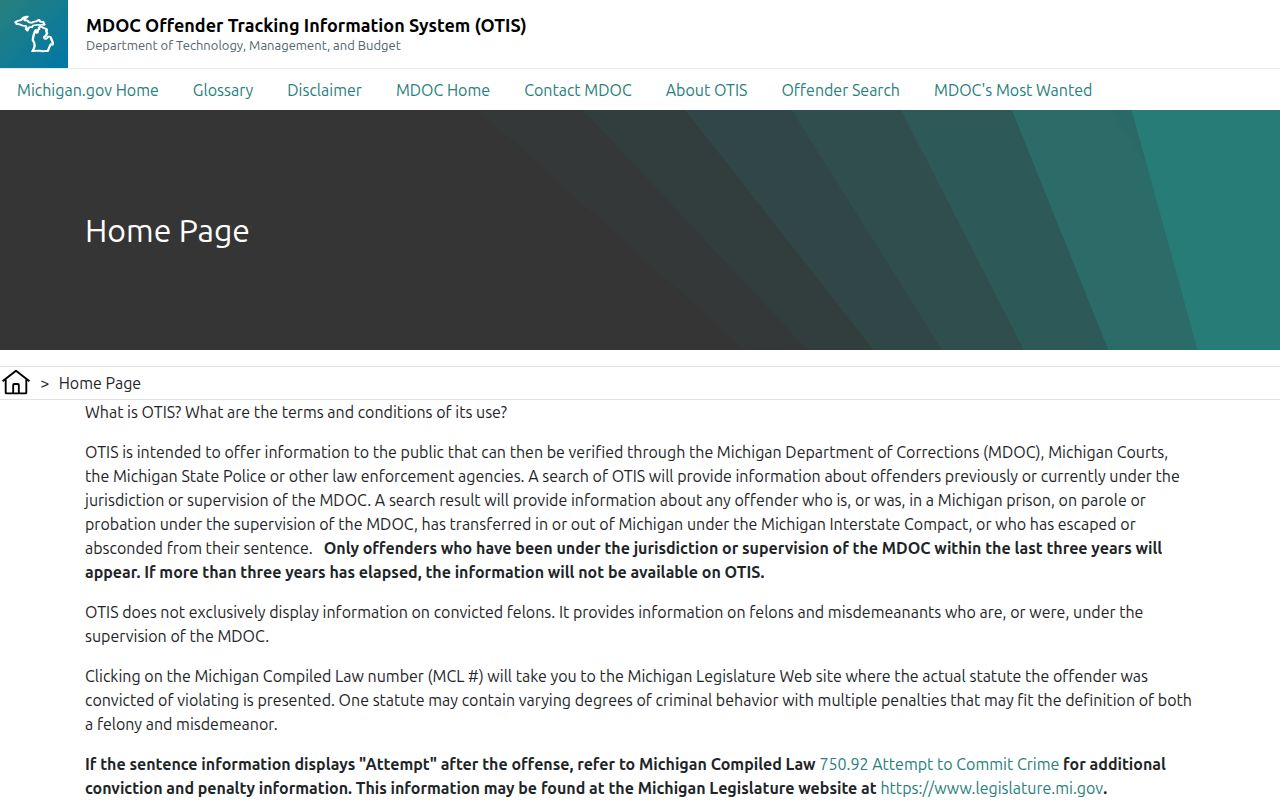
Those inputs locate an MDOC profile. They do not search county jail bookings or replace a request to the local record holder.
Note: A roster view is a short public display, while the custodian's retained file can hold a wider set of booking and release records.
Request Michigan Busted Mugshots
A Michigan FOIA request goes to the public body that holds the record. Want a county booking image? Ask the sheriff, the jail authority, or the arresting police agency. Timing follows a set pattern. The Michigan Attorney General says a public body ordinarily responds within five business days. One ten-business-day extension is allowed. Fees may apply too. The amount depends on the request and each agency's lawful fee calculation.
Name the person and booking date. Identify the county or agency too. A narrow request for the booking card, the photograph, or the release entry routes faster than a demand for every file on a person. If the first office says it lacks the image, ask which agency or jail received the booking.
- Identify the arresting agency and the jail or other current custodian.
- Send a written request that describes the booking record or photo and includes known dates or an incident number.
- Read the response for a release, denial, extension, or fee estimate, then use the agency's appeal path if a denial is disputed.
- For a state-prison record, use the separate MDOC FOIA process and name the profile, intake photo, supervision, or release record sought.
MDOC's FOIA route covers only records in Department custody. It cannot hand over a county jail's original booking card unless MDOC itself holds that record. The agency's public-information and contact pages carry current submission details, so check them before mailing anything. Its offender-photo page explains the separate OTIS profile layer.
Michigan Mugshot Law and FOIA
Michigan does not ban private mugshot publication through any single statewide statute. Nor does it create a general pay-to-remove offense. The real starting point is the Michigan Freedom of Information Act, found at MCL 15.231 and the sections that follow. In Patterson v. Allegan County Sheriff, the Michigan Court of Appeals ruled that a booking photo sitting in a sheriff's files can qualify as a FOIA public record. The ruling addresses access to a public body's record. It does not force sheriffs to post images online.
Exemptions under MCL 15.243, plus other laws, can block release in any given case. Michigan State Police policy for the Statewide Network of Agency Photos leaves release decisions to the originating agency. Agency approval is generally expected unless FOIA compels disclosure. So a photo may count as a sheriff's record. Meanwhile the local roster stays text-only or closed to browsing.
MCL 15.231 sets up FOIA access. MCL 15.243 lists the exemptions. Under Patterson, a sheriff-held photo is a possible public record rather than a required online posting, and retention rules and juvenile limits raise separate questions entirely.
The Michigan Legislature's FOIA text lays out the public-body and public-record framework behind an access request.
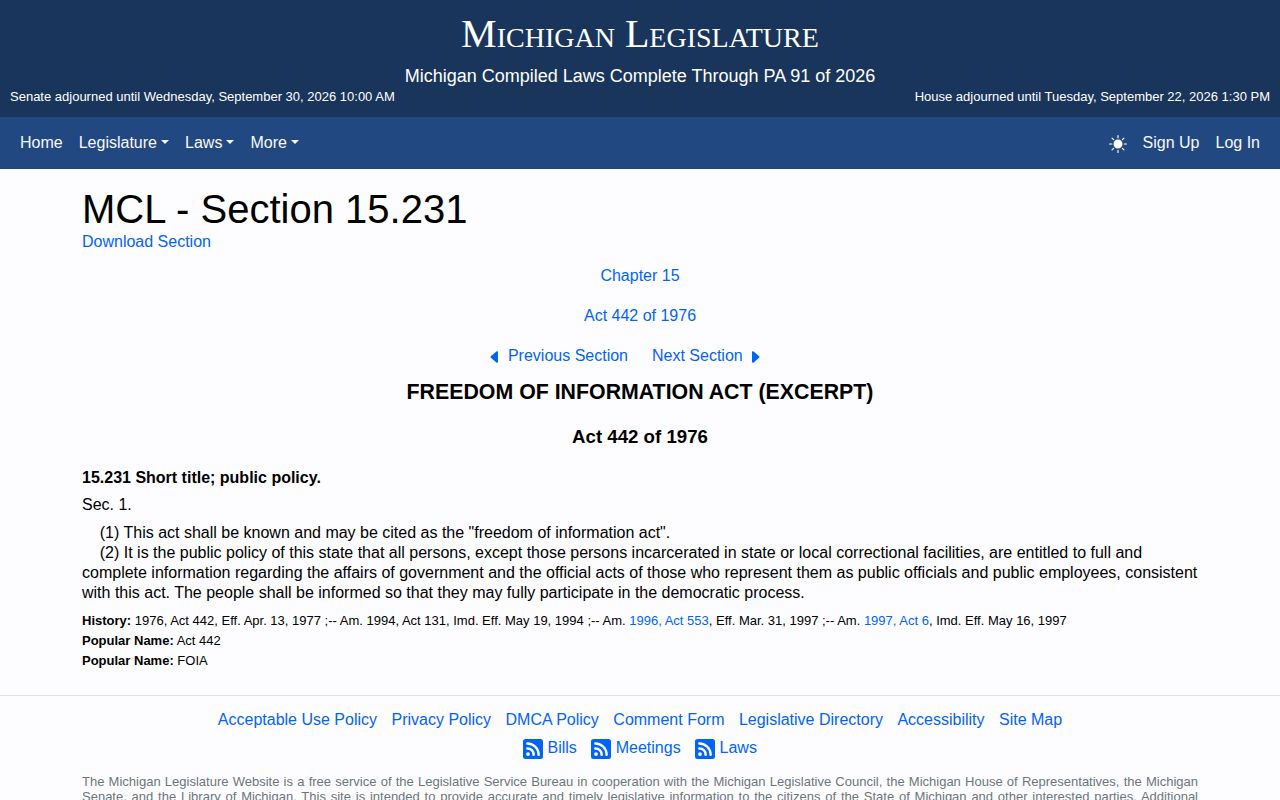
The image shows statutory language, not a booking-photo database. Michigan's law page goes deeper on the case law, exemptions, corrections, set-asides, and publisher correction routes.
Michigan Juvenile Mugshot Limits
Juvenile records take a different road than adult bookings. Michigan's juvenile confidentiality law is MCL 712A.28. It joins the Michigan Courts Juvenile Justice Benchbook in describing tight handling of identifying details, photographs, and biometric material. General Schedule #11, item 11.028, covers juvenile apprehension records. Those records may hold photos and fingerprints. Its retention rule runs through age 21, then destruction follows the schedule and any legal holds. A retention period never grants permission to publish a juvenile's name or image.
Other barriers can arise too. An open investigation can block access. So can a protected victim, witness-safety concerns, or sealed material. Records an agency never created can do the same. Michigan Courts access guidance points out that court rules, not FOIA, govern judicial records. Restrictions can still apply. When a record seems missing, ask the right custodian. Is it withheld, sealed, not yet created, or held elsewhere? A third-party index is no way around a court or juvenile privacy limit. The statute's exemption text helps explain the pattern. FOIA release always depends on the record and its surrounding facts.
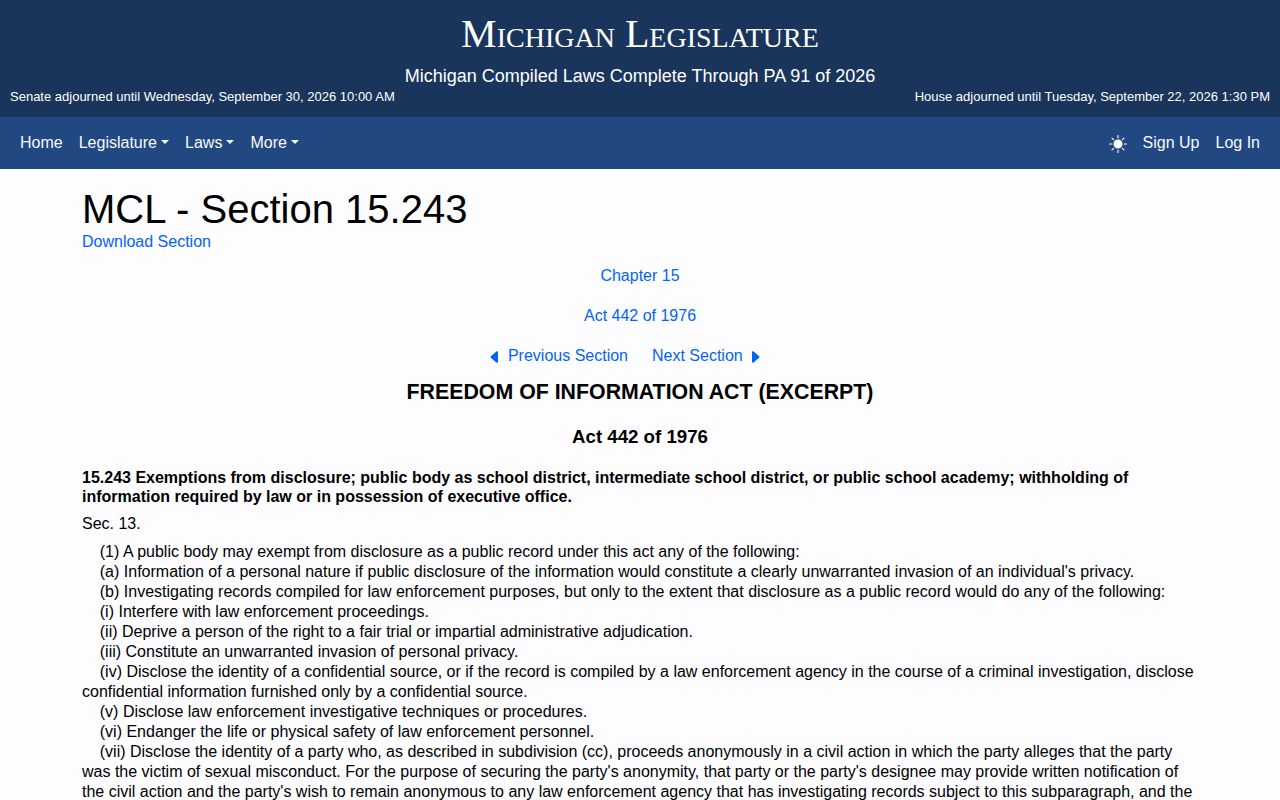
The page shown there displays statutory language alone. Applying that law to a request is the custodian's job, and no public search result settles a confidential-record question.
Old Michigan Arrest and Booking Files
No single public database holds Michigan's old county mugshots. General Schedule #11 assigns different retention periods to different local law-enforcement records. Jail booking and control logs stay on file for the calendar year plus seven. Inmate jackets may contain booking cards and photos. They are kept until release plus ten years. Housing reports and daily count summaries run on shorter schedules. Monthly JPIS reports and midnight-count records preserve aggregate jail data, not a person-by-person photo archive.
MDOC states that OTIS information can stay visible for up to three years. That window runs from discharge from supervision. Research into older prisoner files may need the Archives of Michigan. An agency may destroy a local record once its approved schedule allows. Yet a private copy can still circulate online. The archival route differs from a current custody search. It promises no photograph survives. The old-record page follows the state schedule and the Archives catalog route. The Michigan Legislature's arrest-card statute governs correction or destruction of certain state criminal-history material. That can happen after a qualifying case outcome.
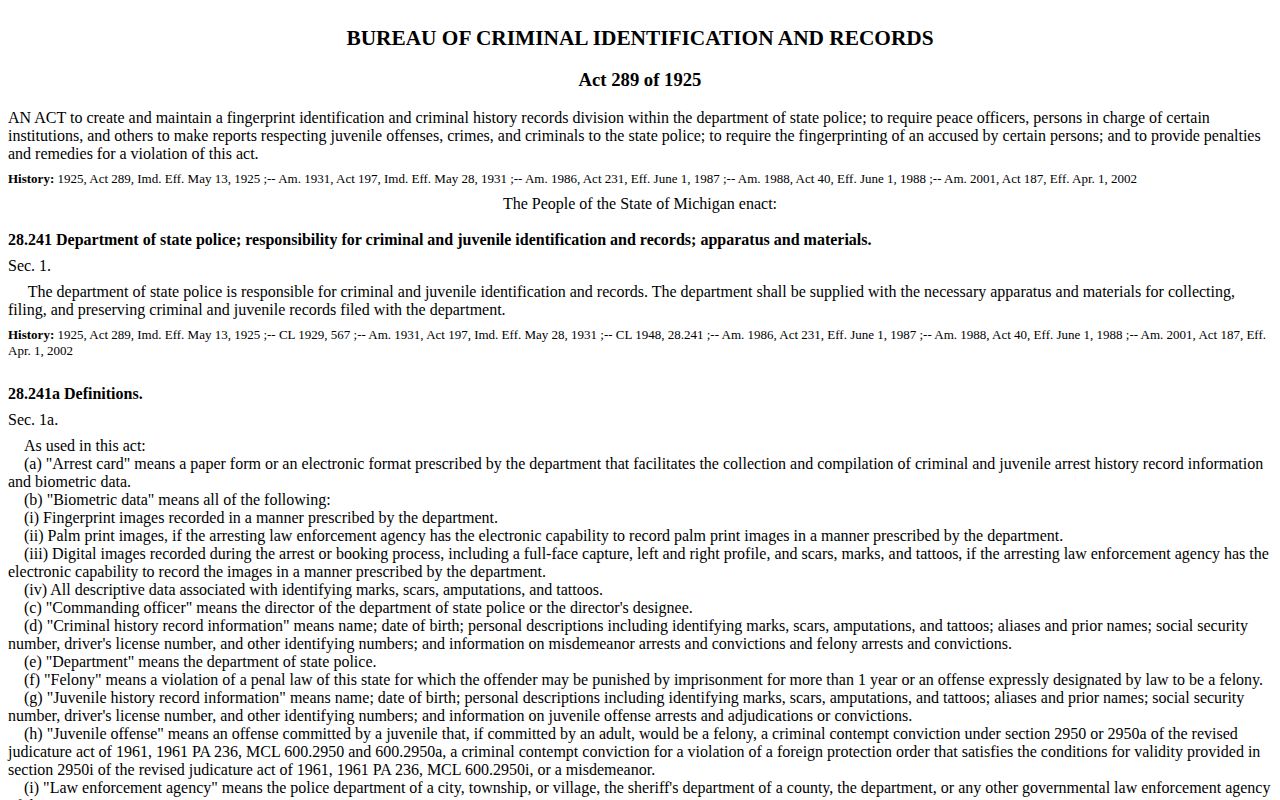
Correcting an arrest card is an official-record process. By itself, it removes nothing that a newspaper, copied image, search cache, or other publisher holds.
Find Michigan Busted Mugshots by Custodian
Start with the office that made the arrest. A statewide name index is rarely the fastest reliable path. A county booking may surface on a sheriff or jail roster. That holds only where the county posts one. Once released, a person can vanish from the current-custody view. The agency may still hold the booking record. For a sentenced state prisoner, use OTIS. Federal custody belongs in the Bureau of Prisons locator or the relevant agency's system. A county jail feed will not cover it.
- Find the county where the arrest occurred and check the sheriff or jail's official roster or booking page.
- If the roster is missing or has no photo, check the arresting police agency and submit a focused FOIA request to the right custodian.
- If the person is serving a state sentence or under state supervision, search MDOC OTIS and review the displayed status and image date.
- Use court records to follow the charge and disposition; use federal or immigration locators only for those custody systems.
OTIS and county rosters answer different questions. Someone missing from OTIS may sit in a county jail, may never have drawn a state prison sentence, or may fall outside OTIS's stated limits. The official OTIS site explains those exclusions and the three-year post-discharge window.
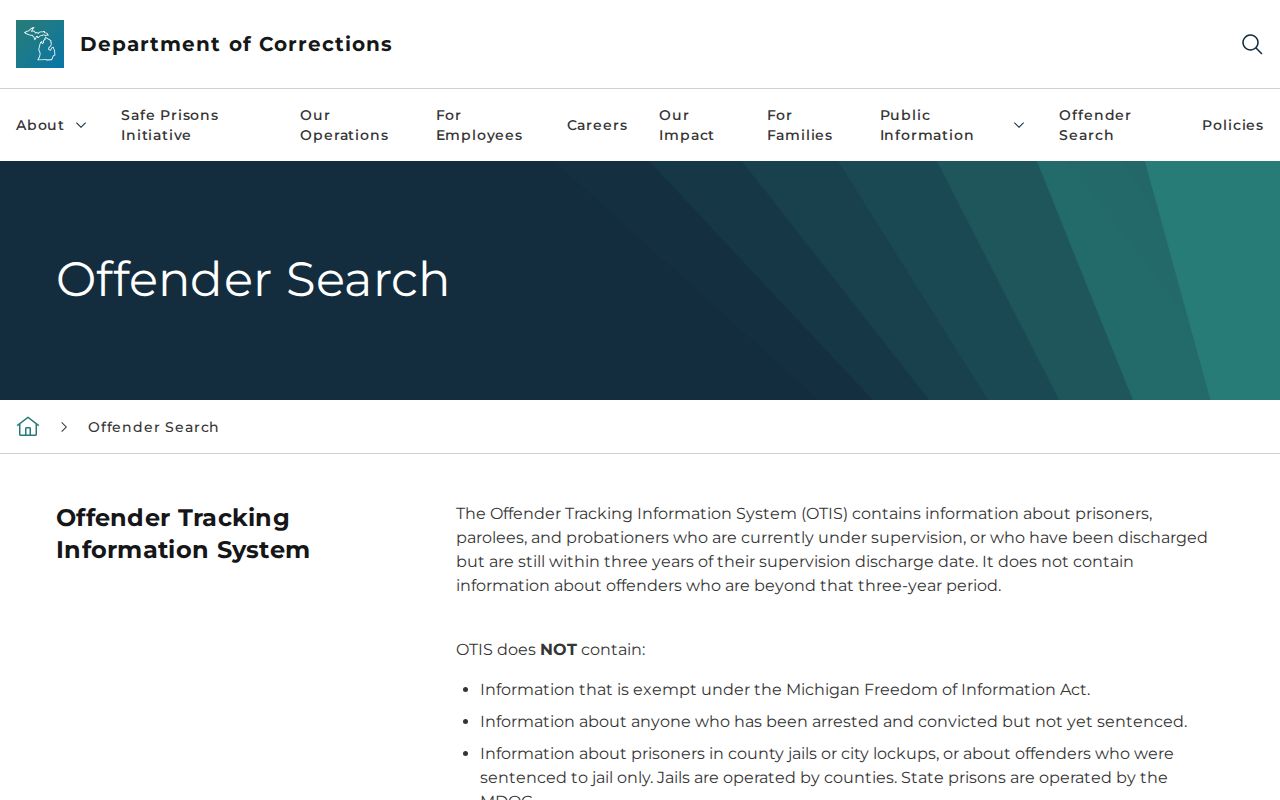
Treat an OTIS result as a state-supervision record. Confirm current status with the agency when that detail matters.
Michigan County Roster and Feed Variation
Michigan runs 83 separate county jail systems. No single state roster covers recent bookings. Counties take very different approaches to public access. Some post a named current-inmate portal. Others offer a generic search page, a press release, or a periodic report. A few publish no roster at all. That silence does not mean no records exist. Regional tools sometimes cross county lines. Lenawee, Oakland, and Washtenaw appear in the CLEMIS inmate locator, with Oakland reporting a lag of roughly 72 hours. JailTracker or Public Safety Cloud shows up in several county files. Monroe and Muskegon use Zuercher interfaces. Session-based vendor pages can shift between visits and may display fewer fields than the custodian actually holds. Treat no portal as a complete same-day statewide photo feed, and check with the county custodian before reading an empty result as proof no booking exists.
Note: A county's public portal can lag intake, omit photographs, or cover a contracted jail in a different county.
Michigan Busted Arrest Feeds and Apps
Booking feeds vary widely across Michigan counties. Some systems list people currently held. Others share a short recent-booking window, a periodic report, or selected news releases. No statewide same-day feed exists. No shared schedule covers all 83 counties either. Where no roster is public, ask the sheriff, the jail, the police records unit, or file a written FOIA request. Sheriff apps add another wrinkle. Many carry news, tips, weather, and road alerts, but not every app serves live booking photos. Check an app's own feature list. MI-VINE is separate from a sheriff app, offering confidential custody and case notifications, such as release or transfer notices, in participating systems. The official MI-VINE page describes that notification service, not a public booking roster or mugshot feed.
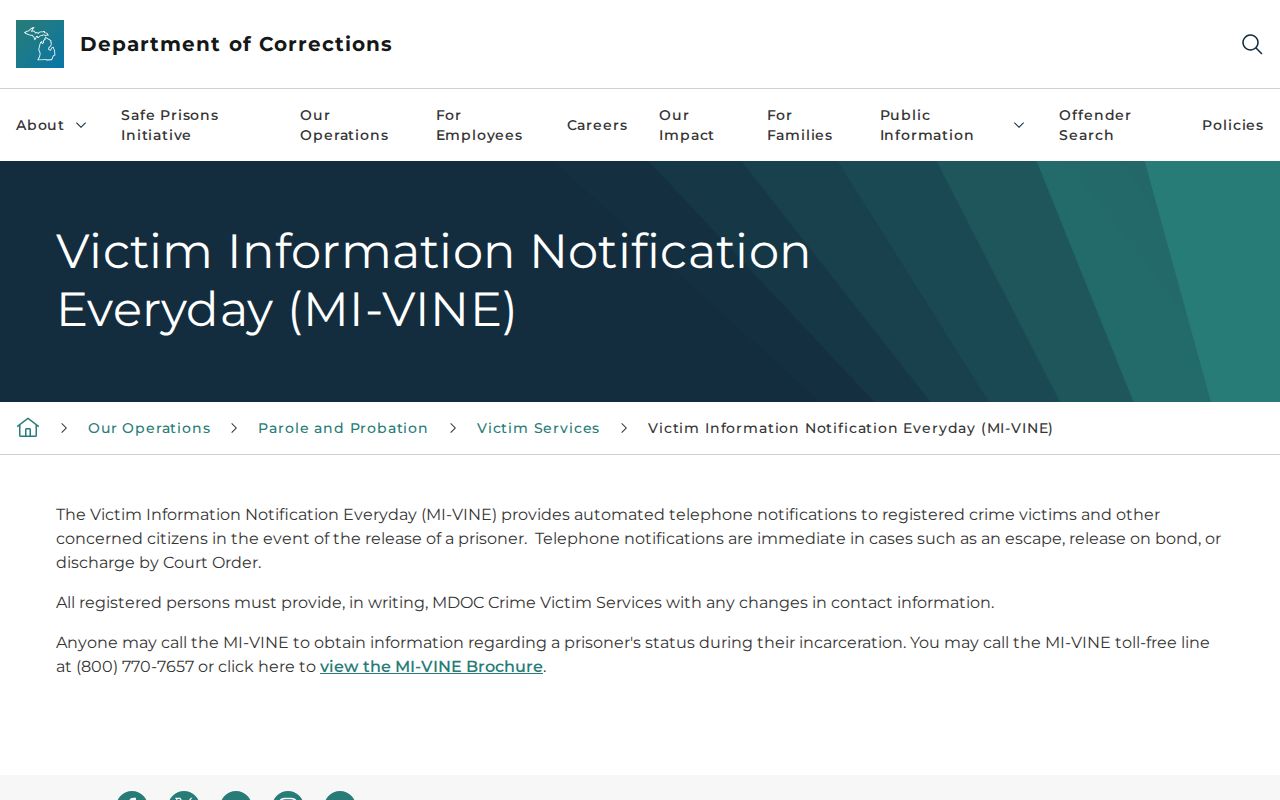
Register with the official service for custody alerts. It will not display a booking photograph, and it does not cover every county event.
Where Michigan Busted Mugshots Appear
| Channel | Has photo? | Official? | How to access |
|---|---|---|---|
| County sheriff or jail portal | Sometimes, by local policy | Yes | Search the county's current roster. |
| Agency FOIA request | If held and releasable | Yes | Ask the public body for the specific booking record. |
| MDOC OTIS | Yes, for applicable profiles | Yes | Search state prison and supervision records. |
| MiCOURT or court clerk | No booking photos | Yes | Search cases; ask the clerk about the official docket. |
| MSP ICHAT | No | Yes | Search eligible reported history, not current arrests. |
| BOP or ICE locator | BOP has no public photo | Yes | Search only the relevant federal or immigration system. |
| Private indexes and publishers | Copies may appear | No | Use as a lead, then verify with the custodian. |
Michigan Secondary Mugshot Indexes
Private mugshot indexes can point you toward a story or a county page. They are not custody sources. They also miss plenty of arrests. RecentlyBooked Michigan displayed a changing subset of counties, not all 83. Coverage there shifts over time. The RecentlyBooked Michigan index shows how thin that slice can be. Mugshots.com presents a broad historic index. Arrests.org offers county and date navigation, with coverage that changes across visits. Mugshots.zone relies on local subdomains that can look county-specific without any sheriff running them. Busted Newspaper keeps a Michigan section too. Its access and county links can change. Treat any hit as a lead only. A private page can be stale or incomplete, missing a later dismissal or conviction, and an official expungement does not automatically erase copied pages or search results.
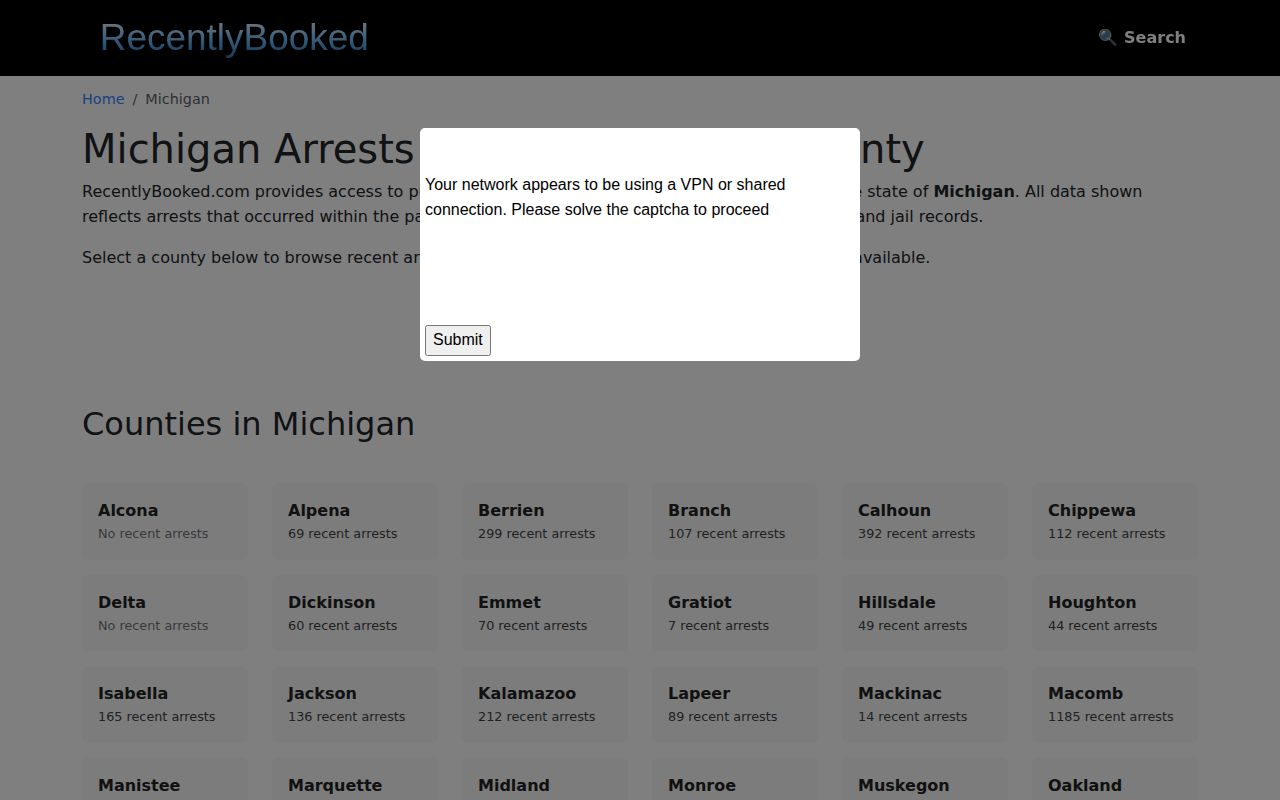
Coverage like that is no completeness claim. The county office holds the booking record, while the court file holds the case outcome.
Michigan Court and History Searches
MiCOURT covers many Michigan court cases. You can search by name or case number. Juvenile, sealed, confidential, older, or locally retained cases may be absent or limited. Court records answer to court rules, not FOIA. The clerk's official docket controls when online data falls short, and the portal is not a live warrant-validation system or a photo source. The MiCOURT case-search screen shows the statewide portal's lookup view.
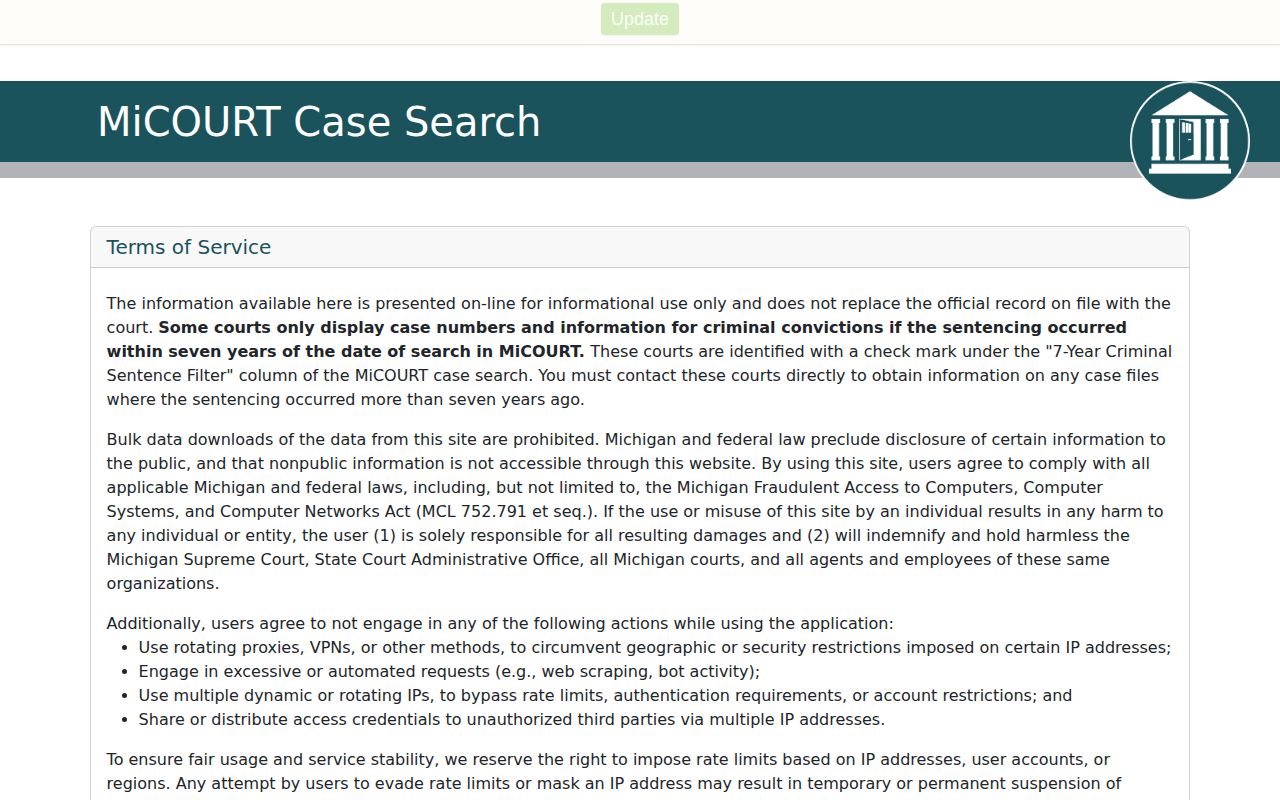
A case-search screen is not a booking roster. Follow the court's official file when a public result is missing or lacks a later disposition. MSP ICHAT works differently. It is a name-based State Police search. Its scope is reported felonies and serious misdemeanors. It is not a real-time arrest feed, and warrants, local misdemeanors, traffic matters, juvenile records, federal or tribal cases, and out-of-state events from Michigan fall outside it. No photos come back either, and the Michigan State Police criminal-history page lays out ICHAT's role and limits.
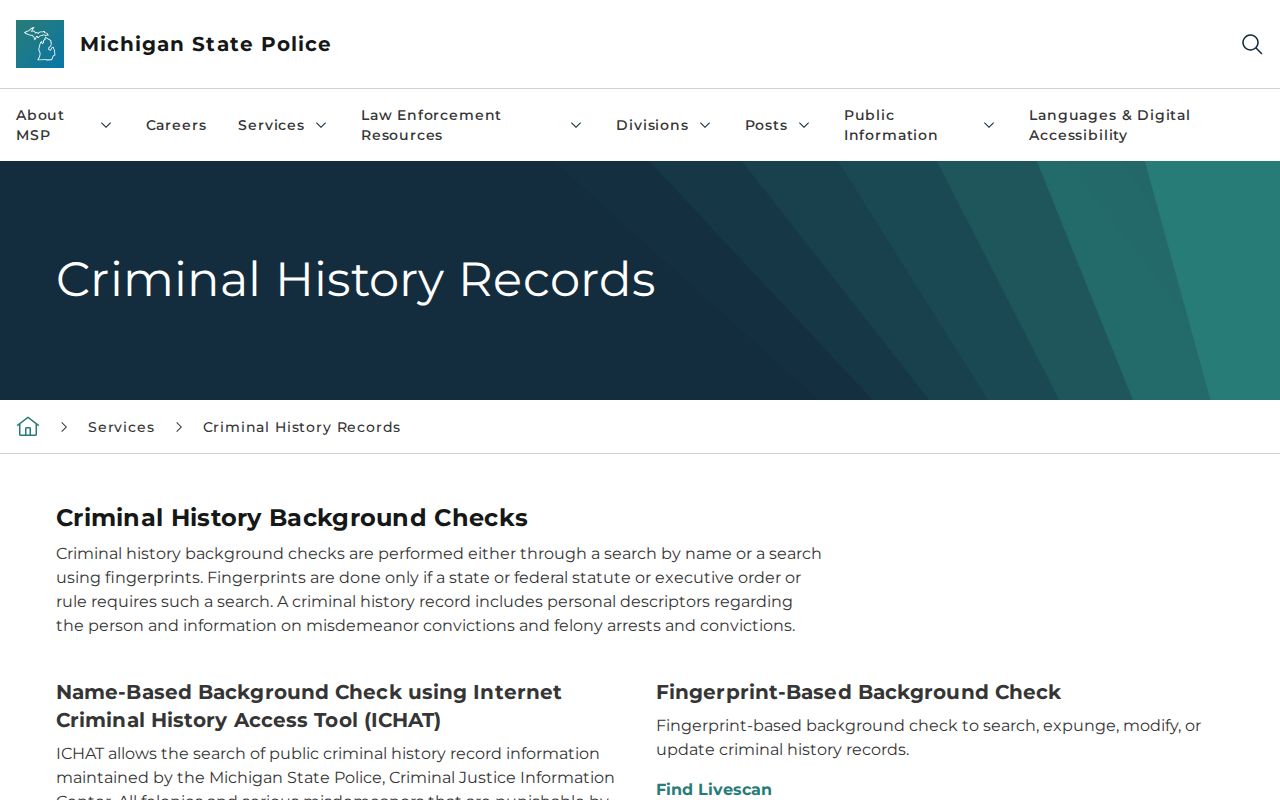
That search never returns a booking photo. Go to the county records unit or jail custodian for a local booking image. Does a missing court result mean no arrest took place? No. A case can sit outside the online portal. It can be confidential or stay in a local court system. Ask the clerk for the docket. Use the police or jail custodian for booking records. Federal custody works differently. The BOP locator covers federal inmates from 1982 forward with daily updates, but its public result has no photo field. ICE's detainee locator handles immigration custody, not county booking. Neither tool replaces a Michigan county roster.
Michigan Busted Mugshots by Custody Layer
One name can sit in several systems at once. A county feed lists a fresh booking or a current jail stay. Release changes the picture. The roster drops the person, yet the booking agency keeps its file. State sentences and state supervision live in MDOC OTIS. Federal custody shows up in BOP or another federal agency's hands. Match the record's source and date before trusting the name.
| Status being checked | Best starting point | What the result can establish |
|---|---|---|
| Recently arrested or booked | Arresting agency and county jail roster or feed | Possible intake or current-custody details, subject to local posting rules and timing. |
| Released from county custody | Booking agency records unit and the court docket | Retained booking material and later case events, if public and held. |
| State prison or supervision | MDOC OTIS and the supervising office | State offender profile and supervision information, not a new county booking. |
| Federal custody | BOP locator or the relevant federal agency | Federal location and status; BOP does not provide public inmate photos. |
Arrest and custody can happen in different counties. Take Alcona. Local intake is limited, and current housing ties to Alpena. So ask two questions. Which agency made the bust, and which holds the person now? The Michigan County Directory points to each local record route.
Note: An arrest location identifies the event, while the current jail identifies who may hold the active custody record.
Busted in Michigan: Official Search Routes
Michigan runs several selective wanted systems. There is no single public list of every active warrant. State Police post a most-wanted page. It includes a tip route. MDOC keeps its own page for featured absconders and wanted profiles. The U.S. Marshals Service publishes selected federal fugitive profiles. Each list has its own agency, legal status, and update cycle. A name left off a list is not proof that no warrant exists.
Want to check a specific Michigan warrant? Find the court or agency that issued it. Then ask that office how to confirm current status. MiCOURT can help locate a case. The statewide portal will not validate a warrant, though. Anyone who spots a possible warrant should not act alone. Talk with a lawyer or the court about safe resolution. Never approach a listed person or try to make an arrest yourself. The Michigan wanted-list page lays out the official tip and verification paths.
MI-VINE sends confidential custody and case notices in participating systems. It does not replace a warrant check or show a photo. Statewide correction reports describe populations and trends, not one person's booking. They draw on MDOC statistical publications and JPIS county-jail data. They answer questions about counts, not about a current inmate.
The BOP interface shows the other boundary. Its public record can give federal location and release data. No booking photo appears there.
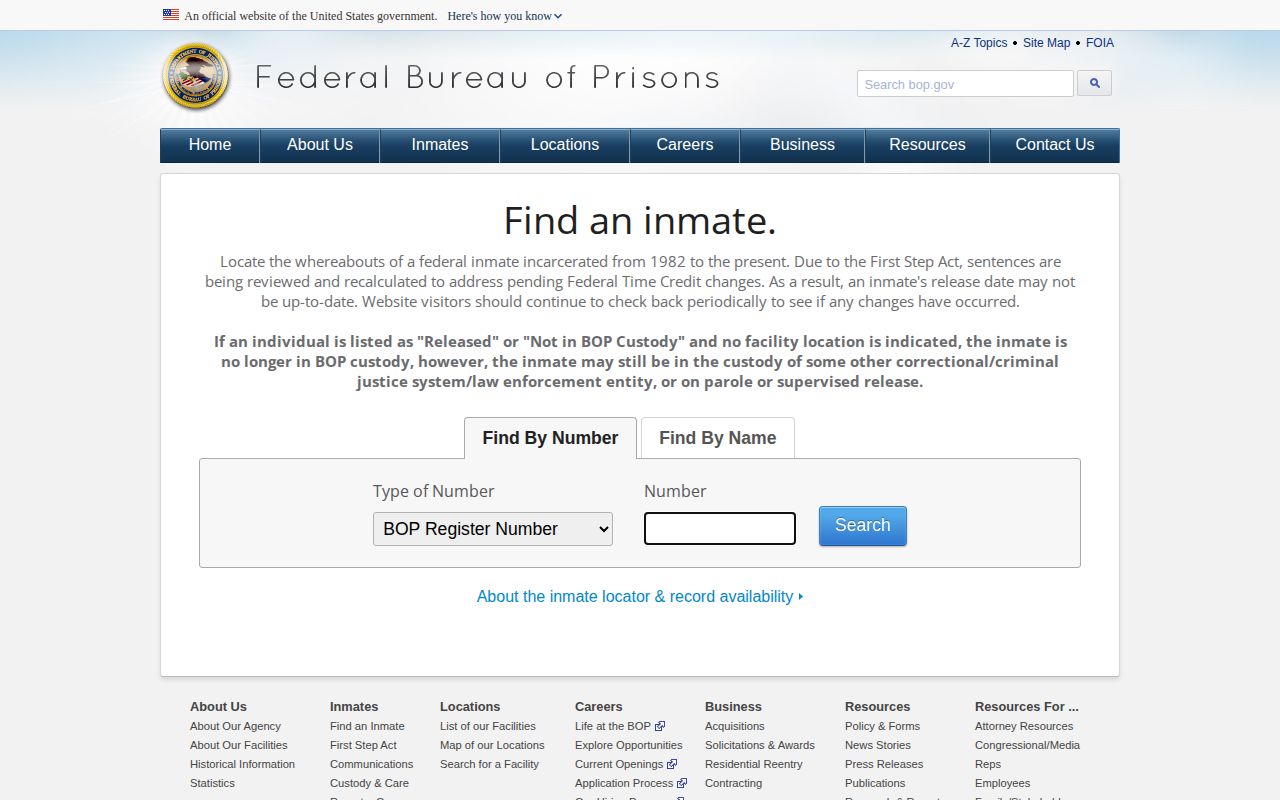
Federal and county records in Michigan answer to different custodians. For a correction or a current-status question, follow the agency named on the official result.
Michigan Records and Trend Reports
MDOC annual and historical statistical reports add context on correctional populations. So does the county-jail information system. General Schedule #11 covers JPIS monthly reports. Those include county counts, crime categories, releases, and sentencing, along with midnight counts and admissions or release data. These are aggregate and administrative records. No live booking list lives there. Quote a number only with its date and purpose stated.
Local arrest counts, roster posts, court filings, and annual jail reports each measure something different. A statewide figure cannot say whether a named person is still in custody. A county news release is not a full booking list. Michigan busted mugshots searches work best when each source is labeled for the record it actually holds: roster, booking file, court docket, offender profile, or aggregate report.
Note: Statistical reports describe systems and populations, not a person's current custody, charge, or court outcome.